More than a Race: The Culture Behind Competitive Swimming
When most people hear that I swim, they think I just swim back and forth, staring at a black line all day, watching the clock. But it's so much more than that. From the outside, it can seem like simply an individual sport - you get your own time, you race in your own lane, etc. However, being in the sport for 7+ years, I have learned that competitive swimming is so much more than an individual sport. There is a bigger culture that is deeper than yourself and so many other teammates and coaches that go into developing your career. We share traditions, specific language and abbreviations, routines, equipment, experiences, etc. that can bond people for life. It is often hard to understand unless you have been apart of the community yourself. That is why I think competitive swimming is ultimately very unique and special because it combines individual progress and success with a strong team identity and culture.
A Culture Built on Shared Experiences - Good and Bad
One of the areas that bond swimmers on teams is the shared pain we have to go through every practice, and the dedication it takes to be at top levels of the sport. We all have a shared understanding of what it takes to get to the top, and we motivate each other to reach our full potentials. We have early morning practices, training for hours each day, injuries, soreness, being exhausted each day and still getting up for practice, etc. We spend a lot of our life around our teammates, so it is almost impossible to not bond with them in some way or another. Even swimmers on different teams are bonded because they can also relate to always being exhausted, waking up before everyone else, pushing yourself during a hard practice, the joy you have when you finally drop time, etc.
This creates a unique type of culture, as the person you are racing is your competitor, but also understands exactly what you are going through. Organizations like USA Swimming also bond swimmers and bring together swimmers and coaches all over the US with their clubs and competitions, which creates a larger community beyond yourself and your team in your hometown.

The Symbols in Competitive Swimming
Competitive swimming has a never-ending list of traditions that are specific and special to this sport. Some people outside of the community may not necessarily understand the traditions at face value. One example is a swim cap - it can represent your school, club team, college team, or country, which makes it apart of a swimmer's identity in the sport. For example, we know Michael Phelps is from the USA partly because of the cap he would wear at every race with an American flag and his last name under it. Caps are used to slick back your hair while swimming so you can swim faster, but it also means so much more than that.
Another symbol is a tech suit. Swimmers have special racing suits that are only used for large competitions that they want to do well at. They are designed with special technology that make them faster for racing, so putting on a tech suit symbolizes that this race matters.
Other examples of symbols in this sport include starting blocks, lane lines, goggles, stopwatches, heat sheets, and medals, which all mean something specific in the context of this sport.
Equipment in swimming has also changed throughout the length of the sport. Each year, World Aquatics tweaks and establishes new rules and regulations for competition, whether international or national. Even the smallest things such as the length you spend underwater during a race can disqualify you in a race, which shows the smallest things can become apart of this sport's culture.
Other Traditions within Teams
There are also traditions that stay within teams and the rest of the world does not know! Such as specific team pre-race routines and training regimes and mechanisms determined by each coach. Traditions that are the same with most teams include relays and teammates supporting each other behind the lanes when their teammates are swimming.
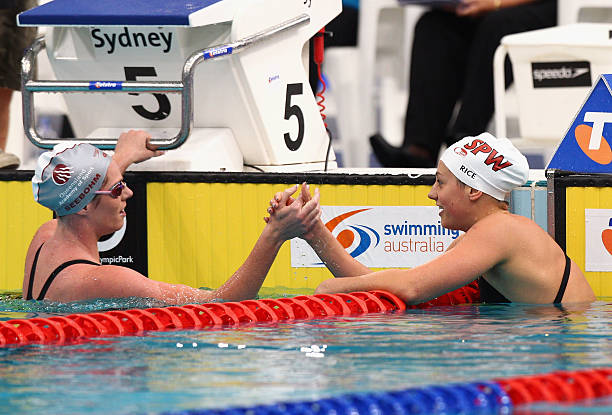
In addition, there is supposed to be a level of respect between competitors after competing against each other in swimming, where you shake their hand or congratulate the person in the lane next to you, regardless if you beat them or not. We can be competitive with someone all we want leading up to a race, but after, there's a level of respect we have to uphold to the person, as they are in the same position as you - training hard every day and hoping for the best result in their career.
An "Individual" Sport
This part of competitive swimming interests me the most. Swimming is considered an individual sport because when I stand behind the blocks, I am the only one who can swim my heart out for me, when I wake up at 4 in the morning, I am the only one who pushes myself to get up and go to practice, during practices, I am the only one who truly puts in the effort to push myself and train to the best of my ability day in and day out. However, I don't do this sport completely alone either. My teammates are the people I train beside each day, who support me in times when I feel like I want to give up, who are there for me when a race doesn't go my way, and lift me up when I need a little extra push. So for me, swimming is never and will never be a truly "individual" sport.
In addition, at high school and college meets, your score contributes to the overall team score, unlike club. In NCAA Swimming and Diving, swimming exists as more of a team sport than club or professional swimming.
This idea has always been interesting to me - you are trying to improve yourself and get the edge beyond your teammates and competitiors, while still encouraging them to be the best they can be and supporting their success as well. This way, you are truly apart of something bigger than yourself.
Where did this culture come from?
We as people have been swimming almost since the beginning of time; our ancestors had to swim to survive and knew how to swim early in Earth's development, but competitive swimming the way we know it now evolved way later. Swimming officially became the one of the sports in the Olympic Games in 1896; however, women's swimming was not included until 1912. Now, swimming has evolved into an international sport, adding high school, collegiate, club, international, and national competitions and teams. The Olympic website shows Olympic swimming history and competition in detail, and how it has developed into one of the forefront sports we have internationally now.


2000s competitive swimming
1900s competitive swimming
More than a Time
At the end of the day, swimming is based on times and based on how fast you can move through water and get to the other side, before your other competitiors. But the number you see on the board at the end of a race doesn't show the pain, tears, effort, the early mornings, the nervous moments, the traditions, thousands of laps prior to the race, the experiences, nor the people behind it. Swimming is so much more than a time, and the moments you have with your teammates during practice and even at meets, is truly what makes it worth coming back to, regardless of your progress at the moment.
This is what truly makes competitive swimming a community rather than just a sport. The time on a scoreboard may belong individually to you, but the experiences, growth, and culture you have while being on a team is shared by the whole community.


Comments